

Buyer Beware, Caveat Emptor
Do the laws in the Bahamas have the buyer’s best interests in mind? Be sure to read this information before reaching out to a real estate agent.

The Bahamas Real Estate Association (BREA) was first established in 1959. Unfortunately, BREA did not have much of an effect on the wild west of the Bahamas Real Estate Industry until the government gave the organization some credibility in 2008. In conjunction with setting up a country-wide multiple listing service (MLS), the government mandated that anyone acting as a real estate agent must be licensed and maintain an active membership in BREA.
Since then, the organization has been doing a fantastic job of maintaining a very high level of discipline within the industry; however, there are some nuances in the BREA code of ethics and standards of practice, and it is very important that newcomers understand that the rules of the game may be a little different in the Bahamas than they are used to.
Three reasons you should use PanCaribbean Consulting Group as your Exclusive Buyer Agent when buying real estate in the Bahamas
1) Buyer Side / Listing (Seller) Side – If a real estate agent is operating within the typical legal framework of the multiple listing system, it should be assumed that the registered real estate commission (typically 6% for a family home and 10% for just about everything else) will be split in half by what we call the “buyer side” and “listing (buyer) side”. That is, the real estate agent representing the buyer and the real estate agent representing the seller. In theory, this assures fair and equal representation for both parties and also enables the industry to function far more efficiently with everyone having a pretty good idea who gets what (beforehand). Now, whilst this may all seem quite straightforward. A lot of newcomers to the country:
a) think they should go straight to the listing agent of a property without understanding that the listing agent is bound by law to represent the best interests of the owner/seller of the property (regardless).
b) and by going straight to the listing agent, they are effectively giving that one agent both sides of the commission split (buyer side and the listing side) while that same agent is ethically and legally obliged to represent the seller side only. And while a lot of smaller agents may offer a small discount on the commission when representing both sides, one should NOT assume that any of the larger franchises would consider such a thing.
c) Did you know that while most states in the USA and many other civilized countries have introduced disclosure laws to protect buyers, the Bahamas (still) has written into the law that the buyer must exercise “Caveat Emptor”.
Caveat emptor is Latin for "Let the Buyer Beware." Generally, caveat emptor is the contract law principle that controls the sale of real property (but may also apply to sales of other goods). The phrase caveat emptor arises from the fact that buyers often have less information about the goods or services they are purchasing, while the seller has more information. Defects in the goods or services may be hidden from the buyer, and only known to the seller. Thus, the buyer should beware. This is called information asymmetry. Credit Wikipedia
Yes - According to BREA’s code of ethics and standards, the seller’s agent SHOULD NOT disclose any information to the potential buyer that may negate a sale. That is: The seller's agent can lose their license if they tell you that anything is wrong, even if they know for a fact that the house is infested with termites, floods every time it rains, and the central air‐conditioner unit is full of indoor mold!
And it gets better - In addition to the seller’s representative, it is also a rule that all standard forms of real estate agency shall have a fiduciary (primary trust) relationship with the seller. That means – according to the BREA code of ethics and practices - that an agent representing the buyer SHOULD NOT disclose any information to the potential buyer that may negate a sale.
UNLESS the buyer has signed an exclusive buyer’s agency agreement with their respective agent.
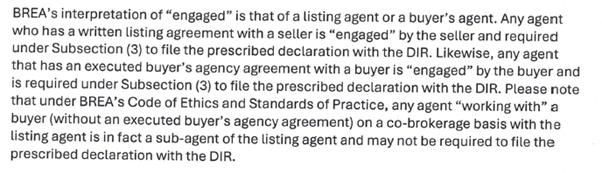
This may seem a little rough on the buyers, but the most important thing to understand is that this is the RULE. Being aware and partnering with an exclusive buyer’s agent is the key to a much happier outcome.
This relatively new form of agency is gaining popularity around the world and is a perfectly acceptable option for a property buyer in the Bahamas as well. Just remember, it must be registered as a formal, signed contract, otherwise the “agency” automatically defaults back to the seller, by law.
3) So now armed with the above information, you hopefully understand that if your intention is to purchase real estate within the Bahamas.
a) you should recruit a real estate agent who does not have anything to do with the property that is for sale (agency-wise)
b) Make sure there is a signed exclusive buyer agency agreement in place between you and your agent
AND
c) Leverage this exclusive buyer agency relationship and a potential commission towards PCCG’s vast depth of expertise when it comes to analyzing and developing said property.
Let us consider a $1,000,000 real estate purchase. The buyer’s agent's side commission on that is theoretically half of 6% = $30,000. By entering into an Exclusive Buyer Agent Agreement with PCCG you are signing on an agent that is legally committed to serving your best interests in a property transaction, all with the option of offsetting some or all of the costs associated with formal research and discovery, qualifying potential repairs and modifications, high-level risk analysis, etc
As well as a steadfast negotiation of price, terms, and conditions in the buyer's best interest.